Battery over WiFi
11 min read

Part one ended with a mouse plugged into one computer and
working on another: netevent reading /dev/input/event8 on a little ARM
board, a socket-activated stream over Tailscale, a uinput clone on the
laptop. The cursor moves, the mouse never found out.
It left one thing behind. The G502 is wireless — it has a battery, it knows how full that battery is, and it tells anyone who asks. On the laptop, the power panel lists the internal battery, the USB-C sources, a Bluetooth keyboard. The one power source I actually hold in my hand is the only one that isn't there.
Worse, nothing on the desk can see it. The ARM board's vendor kernel is
built without Kernel build option that pulls in the Logitech HID drivers. Distributions enable it; vendor board kernels often don't, and the receiver then falls back to hid-generic, which can move a cursor and nothing else. LKDDb entry:
$ zgrep HID_LOGITECH /proc/config.gz
# CONFIG_HID_LOGITECH is not set
So there is no Short for HID++, Logitech's request/response protocol carried inside two vendor-defined HID reports. Features are addressed by 16-bit id — 0x1001 is battery voltage — which you resolve to a runtime index by asking feature 0x0000 first. Arch Wiki driver there, no The kernel class every battery and charger registers with, surfacing as /sys/class/power_supply/*. The scope=Device attribute marks a peripheral's battery rather than the machine's own. kernel docs node, nothing for an
applet to read. The receiver is claimed by hid-generic, which knows how to
move a cursor and nothing else.
Asking the mouse directly
Logitech devices speak HID++ — a small request/response protocol carried in
two vendor-defined HID reports, 0x10 (7 bytes) and 0x11 (20 bytes). If
the kernel won't do it for you, Raw access to a HID device's reports, bypassing any driver that claimed it: open /dev/hidraw*, write a report, read the reply. kernel docs will. Write a request, read the
reply:
buf[0], buf[1], buf[2], buf[3] = rid, dev, feature, (fn << 4) | SW_ID
That's the whole frame: report id, device index behind the receiver,
feature index, and a byte packing the function with a software id so you can
recognize your own answers. Ask feature 0x0000 (the root feature) for the
index of the feature you want, then call it.
115 lines of that, and the receiver's HID++ endpoint gives up the goods:
$ just battery
{"name": "G502 LIGHTSPEED Wireless Gaming Mouse", "voltage_mv": 4057, "flags": 0}
Two details from writing it. First, the only battery feature this mouse
implements is 0x1001, BATTERY_VOLTAGE — millivolts, no percentage.
Remember that, it matters later. Second, my first run returned absolutely
nothing, and the second run worked. A sleeping mouse ignores the first
request; the request is what wakes the link. So the query retries three
times before giving up, and "no answer" genuinely means "off", not "asleep".
The wall
Now put that number on the laptop's screen. GNOME's power panel renders
The freedesktop daemon that collects batteries — almost entirely from the kernel's power_supply class — and exports them on D-Bus. GNOME's power panel is a view of it, so anything it doesn't know about cannot be displayed. upower.freedesktop.org devices, so I need UPower to have one.
UPower has no API for that. You can enumerate devices, you can subscribe to
changes, and there is no AddDevice anywhere on the bus. Its Linux backend
walks the kernel's power_supply class and exports what it finds. (There's
one exception — BlueZ can register a battery provider — and it's no help
unless you're a Bluetooth device.)
That's not a missing feature so much as a boundary. A battery is a hardware fact; the daemon's job is to report hardware facts, not to accept claims about them. Which leaves exactly one way in: the battery has to exist in the kernel.
I considered a Dynamic Kernel Module Support: builds an out-of-tree kernel module automatically against every kernel you install, so it survives upgrades. Arch Wiki module — thirty lines registering a power_supply with
scope=Device, fed from userspace. It would work. But the mouse reports
millivolts, so I'd have to invent the voltage-to-percentage curve myself,
and I'd lose the automatic classification that makes UPower call a battery a
mouse instead of a nameless cell. More code, worse result.
The other option is stranger and much better: if the only interface is being hardware, then be hardware.
Become the mouse
Kernel interface that lets an ordinary userspace process create a HID device: you supply the report descriptor, the kernel binds a driver to it, and every request that driver makes arrives as an event for you to answer. kernel docs lets a userspace process create a HID device. You hand the kernel a report descriptor and some ids, and from that moment the kernel has a HID device it will happily bind a driver to. Everything the driver asks, your process answers.
So the laptop grows a virtual Bluetooth-attached Logitech mouse. The daemon that runs it is The client half of this project: 240 lines of Python that poll zxc-pc for a reading, create the virtual device, answer the driver's HID++ questions out of cache, and push an event when the charge changes. Standard library only.. The in-tree driver that speaks HID++ to Logitech devices and publishes what it finds — battery, high-resolution scrolling, onboard profiles. It also carries Logitech's voltage-to-percentage curve, which is why this project never has to invent one. source binds to it, interrogates it over HID++ exactly as it would a real one, and publishes what it learns:
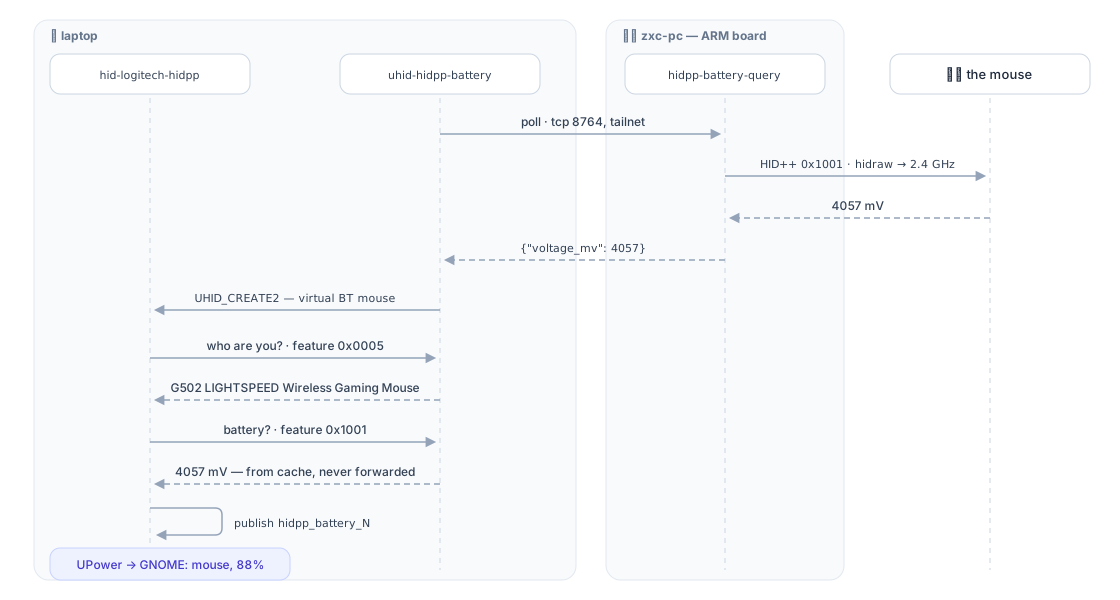
Three parts of the descriptor earn their place. Two vendor collections
declare the HID++ reports — and they must be exactly 6 and 19 data bytes,
because hidpp_validate_device() measures them and refuses anything else.
The third is a plain mouse collection that never emits a single event. It
exists so udev tags a sibling input device ID_INPUT_MOUSE=1, which is what
UPower reads to decide this battery is a mouse. Without it you get a
correct percentage attached to an anonymous battery.
The device id is borrowed. hid-logitech-hidpp matches Bluetooth devices by
explicit product id — 39 of them, no wildcard — so the fake claims one from
that list. It doesn't matter which: the name in the panel comes from the
HID++ answer, not the id.
$ dmesg | tail -1
input: G502 LIGHTSPEED Wireless Gaming Mouse as /devices/virtual/misc/uhid/...
What the driver actually asks
Watching the kernel interrogate a device I wrote is the best part of this whole project. From the first working run, trimmed:
SET_REPORT 11ff000100050000…    getFeature 0x0005 -> index 3
SET_REPORT 11ff031100000000…    → "G502 LIGHTSPEED "
SET_REPORT 11ff031110000000…    → "Wireless Gaming "
SET_REPORT 11ff031120000000…    → "Mouse"
SET_REPORT 10ff001100005a       ping -> HID++ 4.2
SET_REPORT 11ff000110000000…    getFeature 0x1000 -> index 0   (not supported)
SET_REPORT 11ff000110040000…    getFeature 0x1004 -> index 0   (not supported)
SET_REPORT 11ff000110010000…    getFeature 0x1001 -> index 4
SET_REPORT 11ff040100000000…    battery voltage -> 4060 mV
SET_REPORT 11ff000121210000…    getFeature 0x2121 -> index 0   (not supported)
SET_REPORT 11ff000121200000…    getFeature 0x2120 -> index 0   (not supported)
Note the last two lines. 0x2121 and 0x2120 are high-resolution
scrolling, and the driver doesn't only read — given a device that says yes,
it configures it.
That killed the design I wanted. The elegant version of this program is a
transparent tunnel: forward the kernel's HID++ requests over the network to
the real mouse and forward the answers back. Nothing hardcoded, the name and
features come from the device itself. But the far end of that tunnel is a
mouse being driven by hid-generic on the ARM board, and a laptop 30 cm
away deciding to reconfigure its scroll wheel is not a bug I want to debug
six months from now.
So requests are answered, not forwarded. The daemon replies out of a cache it refreshes every five minutes; anything it doesn't serve gets feature index 0, "not supported", which the driver accepts without complaint. Only readings cross the network, and nothing is ever written to the mouse.
The percentage isn't in the mouse
The mouse says 4057 mV. The panel says 88%. Nobody in my code did that
arithmetic — hid-logitech-hidpp carries Logitech's discharge curve, and
passing raw millivolts through means never inventing one:
| millivolts | percent |
|---|---|
| 4057 | 88 |
| 3860 | 60 |
| 3660 | 7 |
That curve is steep at the bottom: 200 mV covers the last 53 points. It's the battery being a battery, and it's a good argument for letting the driver own the mapping.
What to show when you don't know
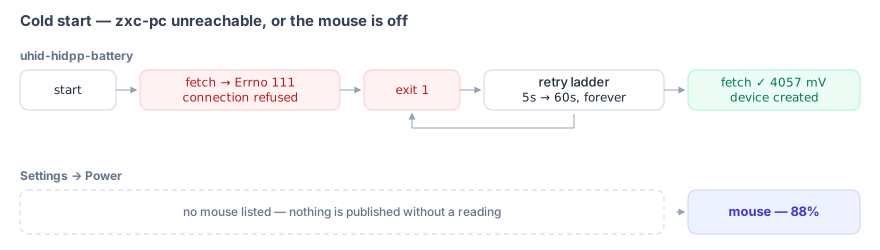
A fabricated device that fabricates data is worse than no device. Everything between the mouse and the pixel breaks independently, and each break needs an answer that stays honest.
Nothing yet. zxc-pc unreachable, or the mouse off, and the daemon exits
before creating anything. Restart=always walks a 5 s → 60 s ladder until a
real number arrives — measured on a real outage at +6, +8, +14, +22, +37,
+60, +60 seconds. StartLimitIntervalSec=0, because a long outage is an
ordinary state here rather than a fault, and the default start limit would
otherwise declare the unit dead and stop trying.
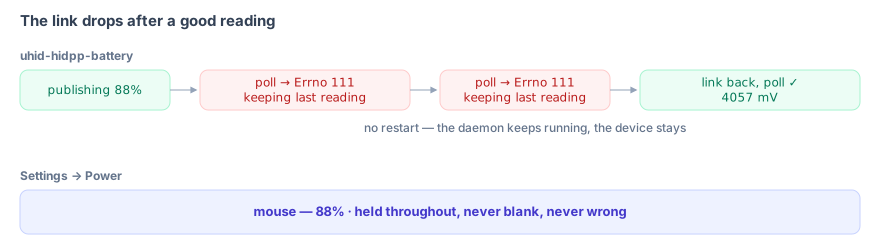
A reading, then silence. After one good number the daemon stays up and keeps it. A mouse that stopped answering has not changed charge, so the panel holding its last value is the truthful answer, not a stale one. I stopped the server socket for five and a half minutes to watch this happen.
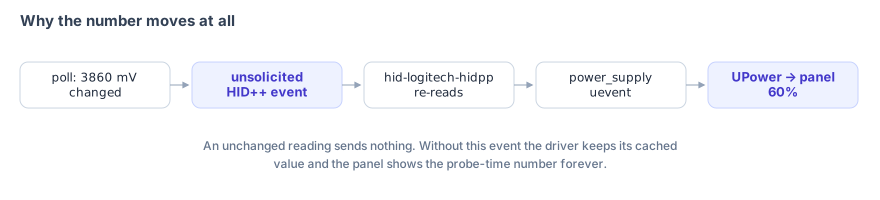
A number that never moves. The driver caches too, so a fresh poll changes nothing by itself. When the reading actually changes the daemon sends an unsolicited HID++ battery event — the same shape of broadcast a real mouse sends unprompted — and the driver re-reads and emits a uevent.
The stream restarts. The battery service is BindsTo= the mouse service,
so a dropped netevent stream takes it down with it — and that propagation
happens on an automatic restart, not only an explicit one. The restart job
pulls it back through Wants=. Nobody has to reconcile anything.
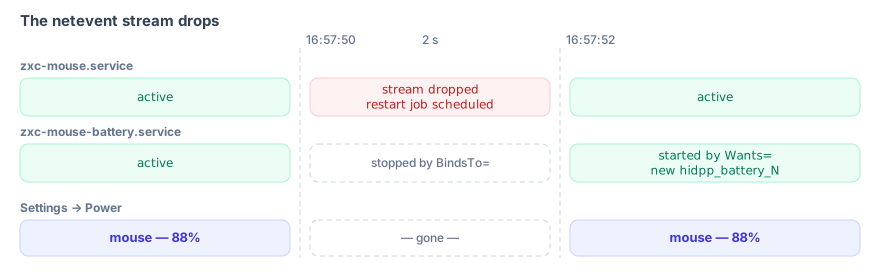
I got that one wrong first. Watching a restart loop in the journal I concluded the design was broken, before noticing I had restarted the daemon myself, by hand, in the middle of the outage I was inducing. The loop was the startup path working correctly. Reading your own logs is a skill and I briefly didn't have it.
Groups, not root
/dev/uhid can create arbitrary HID devices — that is input injection with
extra steps — so it gets its own group rather than being folded into
input, and the service reaches it with DynamicUser=yes plus
SupplementaryGroups=uhid. Same trick as part one, one more group. Ten
minutes after installing that rule I tried to run the daemon by hand:
PermissionError: [Errno 13] Permission denied: '/dev/uhid'
Correct. My user is not in that group and shouldn't be. The security model working as designed feels exactly like a bug until you remember writing it.
On the server side the same instinct applies to the receiver: the udev rule
grants the hidpp group interface 02 only, because interface 00 is the
receiver's keyboard collection, and a group that can read that is a
keylogging surface the day a keyboard gets paired.
Was it worth it?
240 lines on the laptop, 115 on the ARM board, three unit files, two udev rules, no root process on either end, no daemon that knows anything about Logitech beyond four feature ids.
GNOME shows a mouse at 88% and offers no opinion about where it is. The kernel believes there's a Bluetooth mouse attached to this laptop. There isn't — there's a fake device answering questions with numbers that took a round trip across the room to a receiver in a different computer, over Tailscale, to a mouse that has never heard of any of this.
The mouse still hasn't found out.